If you’ve recently walked through a home inspection with me, you probably noticed me checking the hot water temperature at your fixtures. It’s one of those minor details that many homeowners don't think twice about until they realize that setting the temperature dial on a water heater is actually a high-stakes balancing act.
Set it too high, and you risk severe burns. Set it too low, and you turn your water tank into a breeding ground for dangerous bacteria.
So, what is the practical, safe temperature for heated water in a home? Let’s dive into the data, look at the actual burn times, and help you find the perfect setting for your household.
The Danger Zone: Why 120°F is the Universal Baseline
The U.S. Consumer Product Safety Commission (CPSC) recommends setting residential water heaters to 120°F (49°C). There is a very specific reason this number is the standard: it represents the tipping point for human skin safety.
Take a look at how quickly a hot water burn (scalding) can happen at various temperatures:
Water TemperatureTime Required for a 3rd-Degree Burn150°F1.5 seconds140°F3 seconds130°F30 seconds120°FMore than 5 minutes
As you can see, a mere 10-degree jump from 120°F to 130°F slashes your reaction time from minutes to seconds. For households with young children, the elderly, or anyone with slower physical response times, temperatures above 125°F are an immediate safety hazard.
The Hidden Biological Risk: Legionella
If higher temperatures are so dangerous, why don’t we just turn our water heaters down to 110°F or 115°F?
Because of a nasty bacteria called Legionella, which causes Legionnaires' disease (a severe and sometimes fatal form of pneumonia). Legionella thrives in stagnant, warm water—specifically between 68°F and 113°F.
If your water heater tank sits below 120°F, it isn't hot enough to kill the bacteria. Instead, the tank becomes an incubator. When you take a shower, those bacteria become aerosolized in the mist, and you breathe them straight into your lungs.
The Inspector’s Sweet Spot: 122°F to 130°F
During my home inspections, I typically flag water temperatures that fall outside a practical compromise range of 122°F to 130°F.
While keeping the water around 122°F doesn't instantly flash-kill all bacteria, it stops Legionella from reproducing, while still granting you plenty of reaction time to avoid a sudden scald in the shower.
How to Get the Best of Both Worlds
If you want to completely eliminate the risk of bacterial growth and guarantee your family never gets scalded, there is a gold-standard mechanical solution: A Thermostatic Mixing Valve.
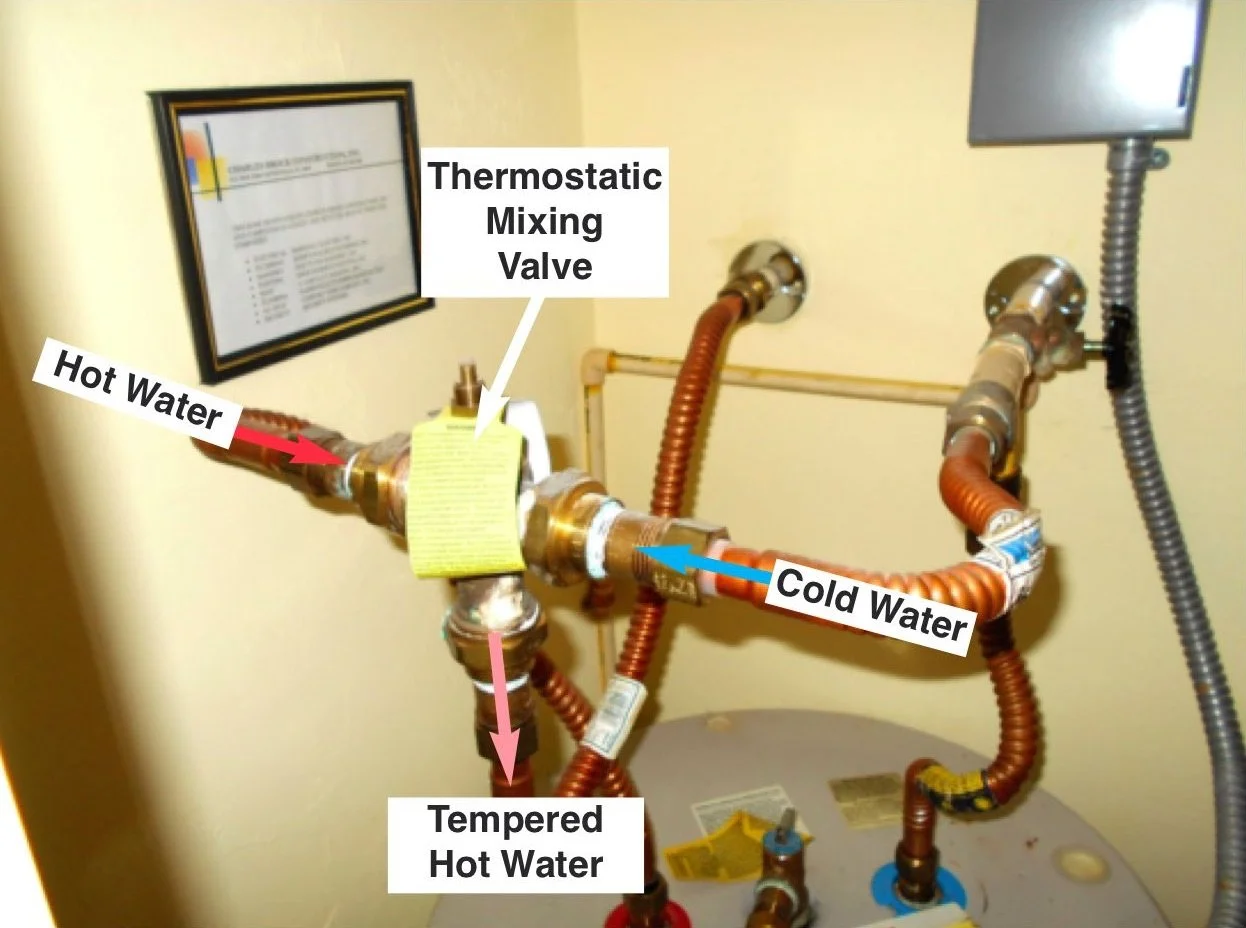
A properly installed thermostatic mixing valve clearly showing how cold water is blended with the hot water line right at the source.
This is a device installed directly at the outlet of your water heater. It allows you to crank your water heater tank up to a bacteria-killing 140°F, but it automatically mixes in a precise amount of cold water right as it leaves the tank. By the time the water travels through your pipes and hits your sinks or showers, it is a perfectly safe 120°F.
What to Do Next
If you suspect your water is running too hot or too cold, you can easily test it yourself. Take a standard kitchen thermometer, run the hot water at your kitchen sink for a minute or two until it tops out, and measure the stream.
If it's over 130°F or under 120°F, it's time to adjust the dial on your water heater tank. (Note: If you have an electric water heater, remember to turn off the breaker before opening the panels to adjust the upper and lower thermostats!)
Have questions about your water heater's age, safety features, or overall performance? Feel free to reach out to me directly or check out our other home maintenance guides.
Henry “Sonny” Toman
1st American Home Inspections
443-388-2410
Serving our neighbors in:
Anne Arundel, Howard, Montgomery, Prince George's, and Baltimore Counties.