Is Your AC Working Hard or Hardly Working?
On a blistering Maryland afternoon, your air conditioner might be screaming at full blast, but the air coming out of your bedroom vent feels... lukewarm. If your system is running constantly but the house isn't cooling down, you aren't necessarily looking at a broken AC unit. You likely have Excessive Thermal Gain.
WHAT IS THERMAL LOSS?
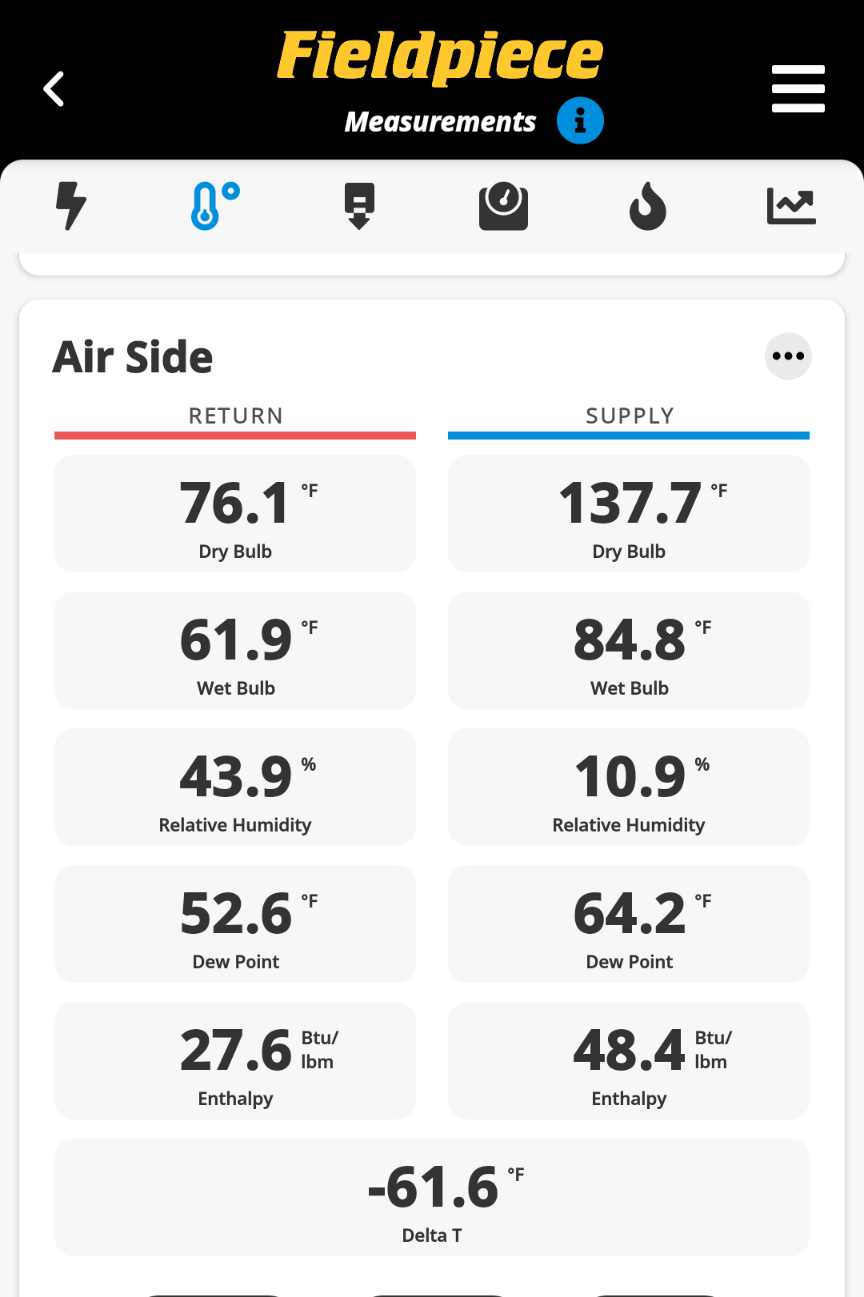
Heating Efficiency Test: Even in winter, thermal loss is a factor. This data shows the warm air losing significant energy as it travels through cold, unconditioned attic spaces before reaching the living areas.
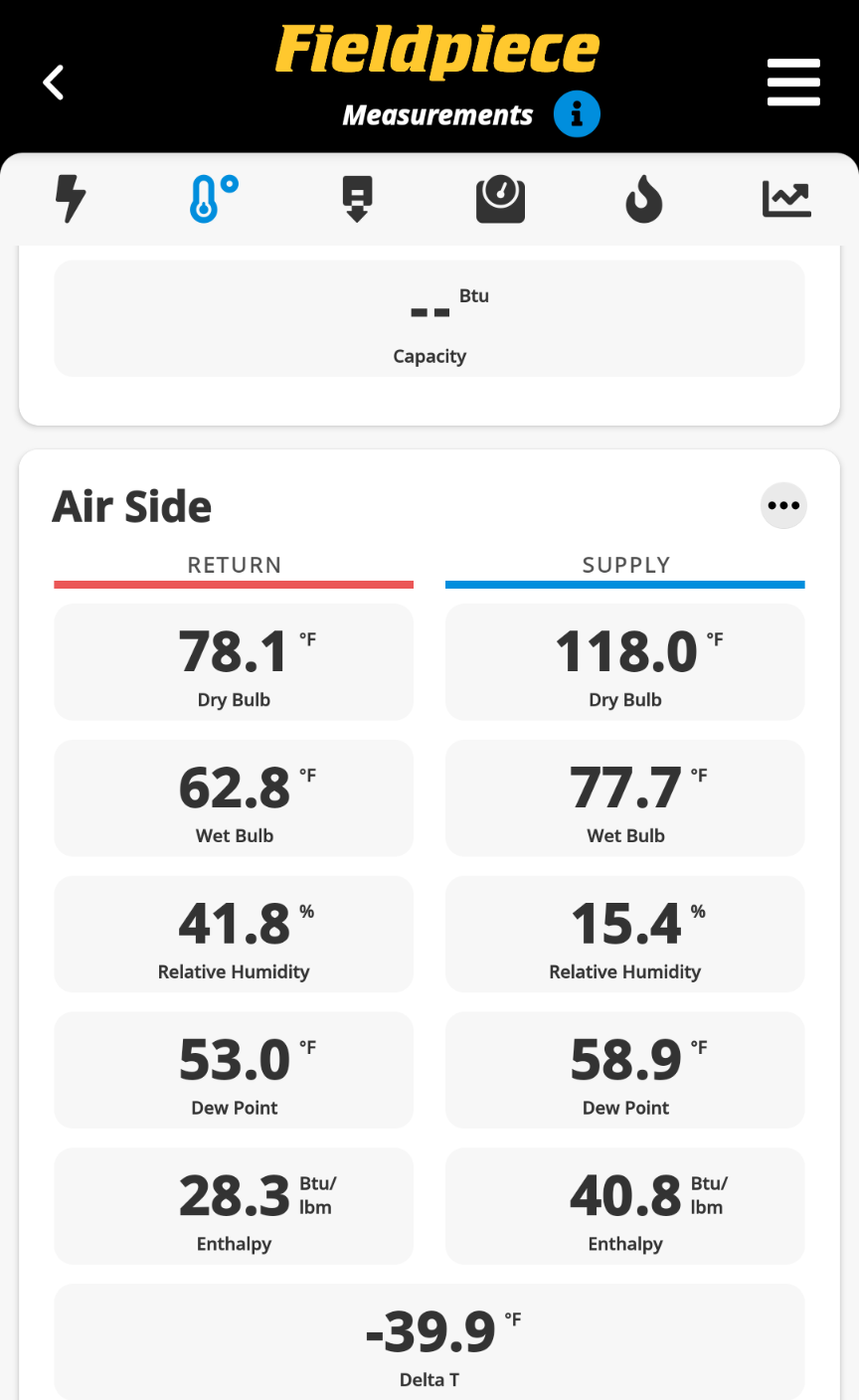
The Delivery: Real-time data showing the air temperature as it enters the living space. By comparing this to the source, we can calculate the exact energy lost.
Think of your ductwork as a "cold-delivery tunnel." If that tunnel runs through a 120-degree attic, the cold air inside starts to warm up before it ever reaches your living room. During your home inspection, we measure the "Temperature Drop." If the air warms up by more than a few degrees on its way through your house, the "cool" is being lost to the unconditioned spaces the ductwork travels through.
PRECISION TOOLS vs. GUESSWORK
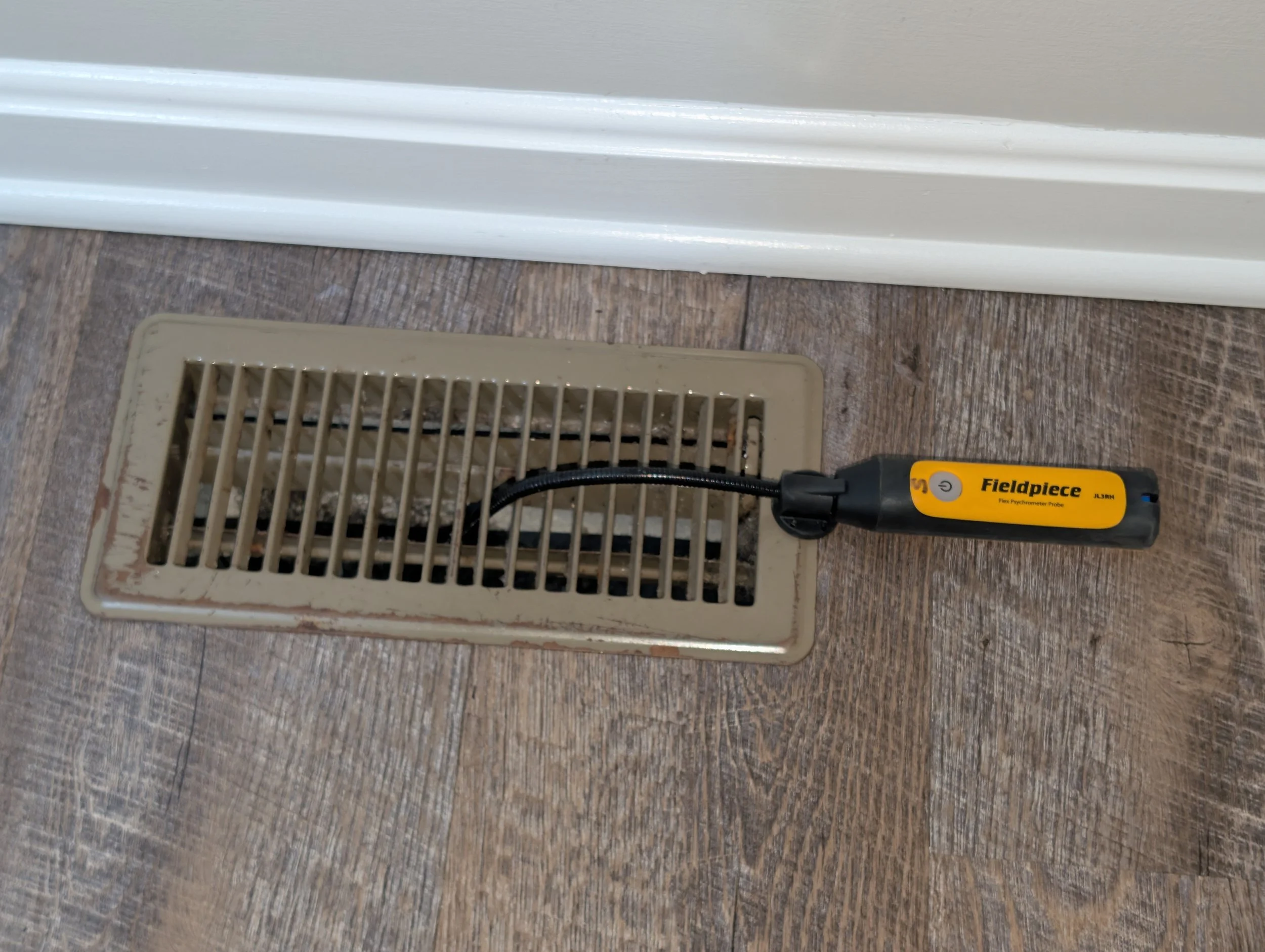
Measuring the ambient air stream at the register with a digital psychrometer. This allows for a precise calculation of thermal loss that standard infrared thermometers simply cannot provide.
Why We Use Professional-Grade Psychrometers During your inspection, we don’t just "feel" the vents. We use a high-precision Digital Psychrometer to calculate the exact temperature rise or drop.
While a standard infrared thermometer only measures the temperature of the plastic vent cover, our psychrometers measure the ambient air stream. This allows us to identify "Energy Bleed" that others might miss. It’s not just about comfort; it’s about verifying that your HVAC system is actually delivering the performance you’re paying for.
Note: While this precision helps us find the 'where' and the 'why' of heat loss, it is important to remember that in many Maryland homes, ductwork is 'built-in.' Our data serves as a roadmap for an HVAC professional to determine the most cost-effective path forward.
THE MAIN CULPRITS:
The "Attic Bake": Many Maryland homes have ductwork in the attic. If those ducts aren't heavily insulated, the attic heat penetrates the metal and warms your air.
Disconnected Ducts: It’s common for duct sections to separate over time. You might be accidentally air-conditioning your attic instead of your master suite.
Leaky Joints: Small gaps at every turn of the pipe let the cold air bleed out into the attic, or other unconditioned spaces.
WHY IT MATTERS TO YOU
Higher Bills: Your AC has to run twice as long to reach the temperature on your thermostat.
Uneven Comfort: The "hot room" in the house will stay hot, no matter how low you turn the dial. This may also have an impact in heating mode.
Equipment Wear: Running your system non-stop leads to premature failure of the compressor and fan motors.
THE “HIDDEN DUCT” REALITY CHECK
In many homes, ductwork is located behind finished drywall or within floor joists. In these cases, accessing the ducts to seal or insulate them is often not cost-effective unless you are already planning a major renovation. If your ducts are 'buried,' the focus shifts from fixing the ducts to managing the airflow.
REALISTIC SOLUTIONS FOR THERMAL LOSS
The "Low-Hanging Fruit": Sealing and insulating ducts in unfinished basements, attics, or crawlspaces. This is where the majority of loss usually occurs.
System Balancing: An HVAC tech can adjust the "dampers" to prioritize airflow to the rooms furthest from the unit.
Internal Sealing: Modern technologies like Aeroseal can seal leaks from the inside of the ductwork without touching your drywall. This can be pricey but worth it if you think you’ve found your dream home.
Supplemental Cooling: Sometimes a mini-split or a ceiling fan is the cheaper, more effective "real world" fix for a room at the end of a long, hot duct run.
Management, Not Miracles: In some older home designs, a small amount of thermal loss is inevitable. Our goal is to ensure you aren't paying for preventable waste.
Henry “Sonny” Toman
1st American Home Inspections
443-388-2410
Serving our neighbors in:
Anne Arundel, Howard, Montgomery, Prince George's, and Baltimore Counties.